
 White Paper
Biosafety Cabinet Field Certification: What Lab Professionals Need to Know


Have you ever wondered what the individual hired to certify your biosafety cabinet (BSC) is actually doing when they are in your lab — or what they should be doing? Biosafety cabinet certification is one of the most important recurring safety requirements in any laboratory that handles biohazardous materials, yet many lab professionals have limited visibility into the process.
This comprehensive guide, authored by Julianne L. Baron, Ph.D., CPH, RBP, covers the complete lifecycle of biosafety cabinet field certification — from initial NSF performance testing through annual recertification — so you can make informed decisions about the purchase, maintenance, and ongoing evaluation of these critical primary containment devices.
In this guide, you will learn:
- How Class II BSCs are performance tested, validated, and certified by NSF International
- When, how, and why biosafety cabinets need to be field certified in your laboratory
- What to expect during the five mandatory BSC field certification tests
- How to find and evaluate a qualified BSC field certifier
- What documentation you should receive after certification
What Is Biosafety Cabinet Certification?
Biosafety cabinet certification is the formal process of verifying that a Class II BSC delivers the three levels of protection it is engineered to provide: personnel protection, product protection, and environmental protection. This verification occurs at multiple stages throughout the cabinet's lifecycle and is governed by the NSF/ANSI Standard 49-2022, which describes requirements from design through disposal.
Class II biosafety cabinets must be specifically designed, constructed, and regularly tested to achieve certain performance criteria. The NSF/ANSI Standard 49 is the formal consensus standard that defines these criteria and ensures BSCs perform reliably in laboratory settings across biomedical research, clinical diagnostics, food and beverage testing, and other industries.
Not sure which BSC class or type you're working with? Review our guide to biosafety cabinet types: Class I, II, and III for a complete breakdown.
How BSCs Are Initially Certified by NSF International
Before a biosafety cabinet model reaches your lab, it goes through a rigorous multi-step certification process:
Step 1 — Design and Manufacturing: The cabinet manufacturer designs, builds, and internally tests the BSC to meet NSF/ANSI Standard 49 performance requirements.
Step 2 — NSF Performance Testing: The manufacturer sends the cabinet model to NSF International for independent validation. NSF conducts 13 physical tests specified in the Standard's Section 6 and Normative Annex N-1, including:
- Pressure decay / tracer gas leak testing
- HEPA/ULPA filter leak testing
- Noise level and lighting intensity evaluation
- Vibration testing
- Microbiological challenge tests for personnel, product, and cross-contamination protection using Bacillus subtilis var. niger spores
- Downflow and inflow velocity measurements
- Airflow pattern verification
- Drainage trough leak testing
- Motor/blower performance evaluation
- Electrical safety testing
- Stability assessment
The most critical of these are the microbiological challenge tests, which use aerosolized B. subtilis spores to verify biological containment. The personnel protection test confirms that particulates and aerosols are contained within the BSC. The product protection test confirms external contaminants cannot enter the work zone. The cross-contamination test confirms that materials inside the cabinet are not cross-contaminated.
Step 3 — NSF Listing: If the BSC passes all tests, NSF places the model on its searchable list of certified biosafety cabinet models. Laboratory purchasers should verify that any BSC model they are considering appears on this list.
Step 4 — Mass Production: The manufacturer mass-produces and sells the certified model. BSCs that pass NSF/ANSI Standard 49 certification receive an “NSF” marking on the cabinet.
Factory Quality Control Testing for Biosafety Cabinets
Once a model is certified and enters mass production, NSF requires the manufacturer to perform documented quality control tests on every cabinet produced. These factory tests include:
- Pressure decay / tracer gas leak testing
- HEPA/ULPA filter leak testing
- Downflow and inflow velocity measurements
- Airflow pattern verification
Additional tests — noise level, lighting intensity, and vibration — must be performed on one out of every ten cabinets manufactured. Notably, microbiological challenge testing is not required on mass-produced units, which is one reason why ongoing field certification in your laboratory is so important.
To understand how individual cabinet types function and why airflow measurement matters, see our detailed guides on how the Class II Type A2, Type B1, and Type B2 biosafety cabinets work.
When Does a Biosafety Cabinet Need Field Certification?
A Class II biosafety cabinet must be field certified in the following situations, as specified by the NSF/ANSI Standard 49, the CDC/NIH BMBL 6th Edition, and the WHO Biological Safety Cabinets monograph:
- At installation — before any laboratory work is performed in the cabinet. For step-by-step guidance, see the NuAire BSC Installation Guide.
- After repairs — any maintenance that may have affected cabinet performance, including HEPA filter replacement.
- After relocation — any time the BSC is moved, even within the same building.
- Annually — at minimum, once per year after initial installation.
For a quick overview of certification frequency, read our article: How Often Does a Biosafety Cabinet Need to Be Certified?
Field certification confirms the BSC is still performing as designed by the manufacturer and certified by NSF International. Without regular certification, there is no assurance that the cabinet's airflow, filtration, and containment are functioning correctly.
The 5 Required BSC Field Certification Tests
BSC field certification testing follows the methods described in NSF/ANSI Standard 49 Normative Annex N-5 and must meet the acceptance criteria provided by both the BSC manufacturer and NSF International. There are five mandatory containment tests (six if the cabinet has a positive pressure plenum) and four optional worker comfort and safety tests.
1. Downflow Velocity Test
This test measures the flow of HEPA-filtered air moving downward over the work surface. A thermal anemometer probe mounted on a stand takes measurements at grid positions specified by the BSC manufacturer. Consistent downflow protects the product from contamination by delivering a uniform curtain of clean, filtered air across the work zone.
2. Inflow (Face) Velocity Test
This test evaluates the flow of room air being drawn into the BSC through the front sash opening. It can be performed using either the Direct Inflow Method (DIM) with a large, tented capture hood device, or a manufacturer/NSF-approved secondary method using a thermal anemometer probe with a manufacturer-supplied fixture. Adequate inflow velocity is essential for personnel protection, as it prevents aerosols from escaping the cabinet into the laboratory.
3. Airflow Pattern Visualization (Smoke Tests)
Four airflow visualization tests use a visible aerosol to assess the BSC's containment performance. These “smoke tests” verify product/cross-contamination protection, personnel protection, and environmental protection by showing whether air is flowing in the correct patterns within and around the cabinet.
4. HEPA/ULPA Filter Integrity Test
A particle generator introduces DOP/PAO aerosol particles upstream of the HEPA or ULPA filters. A handheld photometer is then used to scan the entire filter surface and frame for leaks, measuring the penetration percentage of particles. This test confirms the filters are intact and effectively removing airborne contaminants.
5. Site Installation Assessment
This assessment verifies the proper function of cabinet alarms (sash height alarm, exhaust system alarm, inflow velocity alarm if equipped), the interlock between internal supply and exhaust fans, and the exhaust system connection (hard-ducted, canopy/thimble, or none).
NSF International has published video demonstrations of the downflow velocity, inflow velocity, HEPA filter leak, and smoke tests, including versions with Spanish and Chinese subtitles. NuAire also offers a Biosafety Cabinet Maintenance and Certification Video covering HEPA filter replacement, decontamination, and the importance of certification.
Optional Worker Comfort and Safety Tests
The following tests may be performed at the request of the laboratory user or at the discretion of the certifier:
- Lighting intensity on the BSC work surface
- Noise level generated by the operating cabinet
- Vibration level generated by the functioning cabinet
- Electrical safety (leakage, ground circuit resistance, and polarity) — applicable for BSCs qualified before the 2009 edition of NSF/ANSI Standard 49
Additional testing may be required depending on the industry. For example, biosafety cabinets used in hospital pharmacy sterile hazardous drug compounding operations have separate testing requirements beyond those covered in the NSF/ANSI Standard 49 field certification process. Similarly, cabinets used in non-sterile hazardous drug compounding environments may require additional compliance verification.
How to Select a Qualified BSC Field Certifier
Choosing the right biosafety cabinet field certifier is critically important. Proper field certification requires specialized training, education, and properly maintained and calibrated testing equipment. Here is what to look for:
Seek NSF Accreditation. Search for an accredited individual through NSF International's Enhanced Accreditation Program for BSC field certifiers. NSF-accredited certifiers have demonstrated competency in performing the required test methods.
Involve Your Safety Team. Engage your organization's environmental health and safety (EH&S) or biosafety group in the selection process. They can help evaluate certifier credentials and ensure proper protocols are followed.
Verify Repair Capability. Your field certifier should be able to troubleshoot and repair the cabinet if issues are identified during testing, not just report problems. Regular preventative maintenance between certifications also extends cabinet performance and lifespan.
Confirm Risk Assessment Competency. The certifier should be able to assist with performing a risk assessment if the cabinet requires gas decontamination before certification or maintenance activities, and help select appropriate PPE for handling the BSC during testing.
Familiarize Yourself with the Process. Lab personnel and BSC owners should understand the equipment used and the test methods required by NSF/ANSI Standard 49 Normative Annex N-5. This allows you to identify any discrepancies between standard procedures and what your certifier is actually doing. To build your team's knowledge, explore our resources on working safely in a Class II, Type A2 biosafety cabinet and the 4 steps to take before beginning work in your BSC.
Need a service technician? Use the NuAire Service Partner Locator to find qualified professionals in your area.
What Documentation to Expect After BSC Field Certification
After field certification is complete, a qualified certifier will provide two critical documents:
1. Certification Label
A certification label is physically attached to the front of the BSC in a visible location. Per Normative Annex N-5, it must include:
- Certification test date and retest due date
- Certification test report number
- Certifier information (company name, website or address, and phone number)
- BSC serial number
- Certifier's printed name, signature, and accreditation number (if applicable)
2. Certification Report
The certification report is provided to the lab user for their records and must include:
- BSC model and serial number
- Cabinet location within the facility
- Venting information (ducted or not ducted; canopy, direct, or none)
- Type of BSC
- Testing equipment used (manufacturer, model, serial number, and calibration date)
- Reported test data values and their acceptance criteria
- Certifier's printed name
- Certification test date and retest due date
These records should be maintained alongside your laboratory's biosafety operations manual. For guidance on developing standard procedures, see our resource on what biosafety cabinets are used for and the biosafety cabinet FAQs.
Why Biosafety Cabinet Field Certification Matters
Biosafety cabinets are the primary engineering control devices used to mitigate exposure risk to biohazardous materials, particulates, and aerosols across biomedical research, clinical diagnostics, pharmaceutical compounding, food and beverage testing, and many other industries. Without proper field certification:
- There is no verification that HEPA filters are intact and functional
- Airflow patterns may have shifted, compromising personnel or product protection
- Alarms and interlocks may not be functioning
- Regulatory and institutional compliance requirements go unmet
Understanding the complete biosafety cabinet certification lifecycle — from manufacturer design through NSF testing to annual field certification — empowers laboratory professionals to make informed decisions about the purchase, use, maintenance, and ongoing evaluation of these essential containment devices.
Frequently Asked Questions About Biosafety Cabinet Certification
What is biosafety cabinet certification?
Biosafety cabinet certification is a series of performance tests that verify a Class II BSC provides the three levels of protection it is designed for: personnel protection, product protection, and environmental protection. Initial certification is performed by NSF International against the NSF/ANSI Standard 49. After installation, ongoing “field certification” is performed in the laboratory by a qualified field certifier to confirm the cabinet continues to meet manufacturer and NSF performance criteria.
How often does a biosafety cabinet need to be certified?
A biosafety cabinet must be field certified at the time of initial installation (before any lab work begins), after any repairs or relocation, and at least once annually thereafter. These intervals are specified by the NSF/ANSI Standard 49, the CDC/NIH BMBL 6th Edition, and the WHO Biological Safety Cabinets monograph. Learn more in our article: How Often Does a Biosafety Cabinet Need to Be Certified?
What tests are required during BSC field certification?
BSC field certification per NSF/ANSI Standard 49 Normative Annex N-5 requires five mandatory tests: downflow velocity, inflow (face) velocity, airflow pattern visualization (smoke tests), HEPA/ULPA filter integrity, and site installation assessment. A sixth test is required if the BSC has a positive pressure plenum. Four additional optional tests cover lighting, noise, vibration, and electrical safety.
Is it safe to work in an uncertified biosafety cabinet?
No. Working in an uncertified biosafety cabinet puts laboratory personnel, products, and the environment at risk. Without field certification, there is no verification that the BSC is maintaining proper airflow, HEPA filtration, or containment. The CDC/NIH BMBL and WHO guidelines all require BSCs to be certified before use and on a recurring basis.
How do I find a qualified biosafety cabinet field certifier?
Search for an accredited individual on NSF International's list of accredited BSC field certifiers from their Enhanced Accreditation Program. Involve your organization's health and safety group in the selection. You can also use the NuAire Service Partner Locator to find qualified technicians in your area.
What documentation should I receive after BSC field certification?
After field certification, you should receive two documents: a certification label affixed to the front of the BSC (showing the test date, retest due date, report number, certifier information, BSC serial number, and certifier signature) and a certification report for your records (including BSC model/serial number, cabinet location, venting information, BSC type, test equipment details with calibration dates, test data with acceptance criteria, and certifier name).
Explore NuAire Biosafety Cabinets
NuAire manufactures a full range of NSF/ANSI Standard 49-certified Class II biosafety cabinets, including Type A2, Type B1, and Type B2 models engineered for personnel, product, and environmental protection in critical research environments.
View All Biosafety Cabinets → | Request a Quote → | Request Service →
References
- NSF/ANSI 49-2022 Biosafety Cabinetry: Design, Construction, Performance, and Field Certification: https://webstore.ansi.org/standards/nsf/nsfansi492022
- CDC/NIH Biosafety in Microbiological and Biomedical Laboratories (BMBL) 6th Edition: https://www.cdc.gov/labs/BMBL.html
- WHO Biological Safety Cabinets and Other Primary Containment Devices monograph: https://www.who.int/publications/i/item/9789240011335
- NSF/ANSI 49-2022 Normative Annex N-5 (Formerly Annex F): https://webstore.ansi.org/standards/nsf/nsfansi492022annex-2495065

Related Resources

HEPA versus ULPA Filters in Biosafety Cabinets

Leverage USP Training to Drive Technician Retention


LabGard NU-581 (115V) Class II Biosafety Cabinet Specification

Aeromax Biosafety Cabinet Control System Introduction
Setting the Blower Password on the Aeromax Control System
Setting the Light Timer on the Aeromax Control System

Reacting to Alarms in Your Class II, Type A2 Biosafety Cabinet
Biosafety Cabinet Construction Matters
Buying a Biosafety Cabinet Making an Informed Decision
Creating a Biosafety Cabinet Training Program
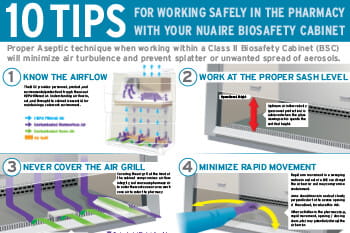
10 Tips for Working Safely in the Pharmacy with Your Biosafety Cabinet